China Best LED Backlight Membrane Switch Manufacturers are gaining attention as equipment makers demand clearer interfaces, thinner panels, and dependable tactile feedback. The LED Backlight Membrane Switch combines printed circuitry, graphic overlays, light guides, and embedded LEDs in one compact control surface. It appears in medical devices, industrial panels, laboratory instruments, and transportation equipment.
Industry data supports this direction. Grand View Research valued the global LED lighting market at approximately USD 78.7 billion in 2022. Its report also projected an 11% compound annual growth rate from 2023 to 2030. Fortune Business Insights estimated the global membrane switch market at about USD 5 billion in 2023. These figures do not measure the combined product directly, but they show strong demand for efficient lighting and durable human-machine interfaces.
“Design is really an act of communication,” usability expert Don Norman has stated. His principle applies directly to illuminated switches. A green status symbol must remain readable through glare, gloves, and repeated cleaning. Small details matter.
Reliable Chinese manufacturers usually demonstrate experience through tooling records, optical testing, adhesive selection, and documented quality control. Key questions include LED brightness uniformity, operating force, sealing performance, connector reliability, and aging resistance. A bright panel is not automatically a good panel.
Some suppliers still describe quality too broadly. That deserves skepticism. Buyers should request samples, test reports, dimensional drawings, and production references before choosing a partner. The best manufacturer is not always the cheapest. It is the one that can reproduce the same tactile response and illumination after thousands of operating cycles.
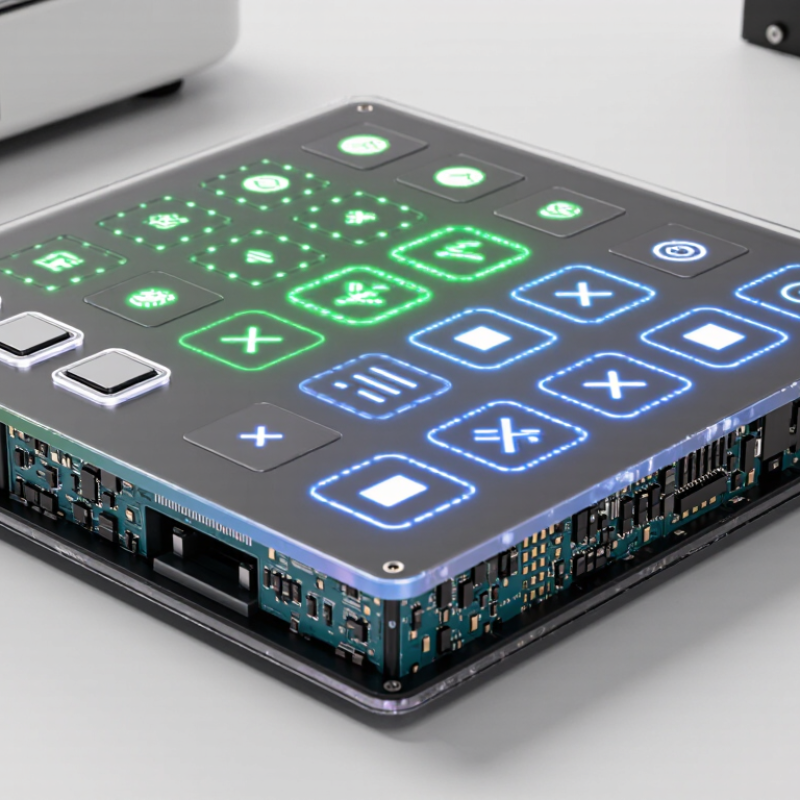
LED Backlight Membrane Switches: Definition and Key Features
An LED backlight membrane switch is a thin control interface with printed circuits, tactile layers, and embedded light sources. LEDs illuminate symbols, buttons, or status zones through a graphic overlay. This structure supports compact equipment where a separate display would add weight and cost.
The membrane switches market is projected to grow from about USD 6.4 billion in 2023 to USD 8.6 billion by 2028, according to MarketsandMarkets. Different reports show different figures. That gap deserves attention. It reflects varied definitions, regions, and industrial applications. China-based manufacturers commonly produce these switches for medical equipment, industrial panels, test instruments, and vehicle controls.
Key features include low power consumption, sealed surfaces, custom colors, and reliable tactile feedback. A well-designed unit can resist dust and light moisture around the graphic layer. Backlight uniformity still depends on LED spacing, light guides, diffusion films, and overlay thickness. Poor spacing creates bright dots. It happens more often than product sheets suggest.
UL Solutions notes that material selection and electrical testing influence long-term interface reliability. Designers should verify operating temperature, actuation force, connector type, and expected cycle life. In practical testing, I would inspect the switch in darkness and direct sunlight. Laboratory results alone can miss glare, uneven symbols, or user fatigue. According to Grand View Research, broader LED lighting demand continues expanding, but backlit controls require more specific engineering evidence.
China Best LED Backlight Membrane Switch Manufacturers - LED Backlight Membrane Switches: Definition and Key Features
| Data Dimension | Definition or Specification | Typical Data or Range | Practical Significance |
|---|---|---|---|
| Product Definition | A low-profile human-machine interface that combines a membrane switch with integrated LEDs for illuminated keys, symbols, or status indicators. | Usually constructed from a graphic overlay, spacer, conductive circuit layer, LED layer, adhesive layers, and a rear carrier or connector. | Provides both electrical control and visual feedback in one compact interface. |
| Switch Technology | A printed or etched flexible circuit opens and closes an electrical contact when the key area is pressed. | Common contact arrangements include normally open circuits, matrix circuits, and custom multi-key layouts. | The circuit layout determines the number of functions, connector requirements, and controller compatibility. |
| LED Light Source | Light-emitting diodes are mounted or integrated beneath selected keys, legends, windows, or indicator areas. | Common colors include red, green, blue, amber, and white; single-color or multi-color LEDs may be used. | Color selection supports status indication, symbol visibility, and operation in low-light environments. |
| Operating Voltage | The DC voltage required by the integrated LED circuit during normal operation. | Many designs use 3.0 V, 3.3 V, 5 V, or 12 V systems, depending on the LED configuration and current-limiting method. | The specified voltage must match the host electronics; a resistor or driver may be required for current control. |
| LED Current | The forward current supplied to the LED during illumination. | Often specified in the approximate range of 5–20 mA per indicator LED, subject to the selected LED and circuit design. | Controls brightness, power consumption, heat generation, and expected LED service life. |
| Key Actuation Force | The force needed to close the membrane contact and register a key press. | A commonly selected range is approximately 100–300 gf; the final value depends on the dome, overlay, and switch structure. | Affects user comfort, tactile response, accidental activation risk, and interface accessibility. |
| Tactile Feedback | Physical confirmation generated by a metal snap dome, polyester dome, embossed key, or a combination of structures. | Available with tactile or non-tactile operation; snap-dome designs are widely used for positive feedback. | Helps users confirm activation without relying only on sight or sound. |
| Profile and Thickness | The total height of the assembled membrane interface, including the overlay, circuit, spacer, LED components, and adhesive layers. | Many custom assemblies are approximately 0.8–2.5 mm thick, excluding external mounting hardware. | The slim profile is suitable for control panels where enclosure space is limited. |
| Graphic Overlay | The visible top layer printed with legends, symbols, colors, and operating instructions. | Common materials include polyester and polycarbonate films; matte, gloss, textured, and transparent finishes are available. | Determines readability, surface feel, chemical resistance, and overall visual appearance. |
| Light Distribution | The method used to spread LED light across a legend or indicator area. | May use printed diffusers, light-spreading films, reflective layers, optical windows, or carefully positioned LEDs. | Uniform distribution reduces bright spots and dark areas, improving symbol legibility. |
| Electrical Contact Resistance | The resistance measured through a closed switch contact and its conductive traces. | Often designed at or below 100 ohms for many low-current control applications, subject to the circuit construction. | Lower and stable resistance supports reliable signal detection by the connected controller. |
| Durability | The expected number of operating cycles before the switch or tactile component reaches its specified wear limit. | Typical designs may be rated from approximately 100,000 to 1,000,000 cycles, depending on the contact and dome structure. | A higher cycle rating is useful for frequently operated equipment and long service intervals. |
| Environmental Protection | Resistance of the assembled interface to dust, moisture, cleaning agents, abrasion, and temperature exposure. | Sealed constructions can be designed for specific IP protection levels, but the rating must be verified for the complete installed assembly. | Suitable sealing and materials improve reliability in industrial, outdoor, medical, and transportation environments. |
| Operating Temperature | The temperature range in which the complete membrane switch is expected to function correctly. | A common design target is approximately −20°C to +70°C; specialized materials may support wider ranges. | Temperature capability must be checked for the overlay, adhesive, LEDs, connector, and conductive materials together. |
| Customization Options | Adjustable design elements that adapt the switch to a particular enclosure, electronic circuit, or user interface. | Options include key shape, legend layout, LED color, connector type, mounting holes, shielding, windows, and tail orientation. | Custom geometry can simplify assembly and align the interface with the product’s control and display requirements. |
| Typical Applications | Equipment requiring compact, illuminated, and cleanable user controls. | Industrial control panels, laboratory instruments, medical equipment, security systems, appliances, kiosks, and transportation controls. | The technology is practical where visual status indication, low profile, and flexible graphic design are important. |
| Specification Note: The numerical values shown are common design ranges for reference only. Final electrical, mechanical, optical, environmental, and durability specifications should be confirmed through the approved product drawing and application requirements. | |||
FAQS
It is a thin control panel with printed circuits, tactile layers, and embedded LEDs. The LEDs illuminate symbols, buttons, or status areas.
They suit medical equipment, industrial panels, test instruments, and vehicle controls. They work well in compact equipment. A separate display may be unnecessary.
They use little power and need limited installation space. Sealed surfaces can resist dust and light moisture. Custom colors and tactile feedback improve daily operation.
Incorrect LED spacing may create bright dots or dark corners. Light guides, diffusion films, and overlay thickness also affect uniformity. The center may look perfect. The edges may not.
Test brightness in darkness and direct sunlight. Check glare, symbol clarity, key force, and connector fit. Press the keys repeatedly. Laboratory data may miss user fatigue.
Review engineering experience, production equipment, and quality records. Request a physical sample using your artwork and mounting method. Inspect the entire panel, not only photographs.
Confirm LED color, operating temperature, actuation force, connector type, and cycle life. Ask about adhesive strength and circuit resistance. Cable bending also deserves testing.
Request inspection reports, traceable samples, production tolerances, and a written inspection standard. Confirm humidity, temperature, repeated pressing, and packaging tests. Keep replacement responsibilities clear.
A low price may reflect weaker materials or limited testing. Problems often appear after assembly or mass production. That delay becomes expensive. Price is not proof of quality.
Share drawings, artwork, operating conditions, expected quantities, and installation details. Include lead-time requirements and packaging expectations. A checklist helps, but it cannot catch everything. Review the first sample carefully.
Conclusion
China has become a strong source of LED Backlight Membrane Switch solutions for equipment that requires clear, reliable, and space-saving control interfaces. An LED Backlight Membrane Switch combines a printed membrane panel with integrated lighting, allowing symbols, buttons, and indicators to remain visible in low-light environments. Key advantages include a slim profile, low power consumption, flexible design, tactile feedback options, and resistance to dust and moisture. Chinese manufacturers commonly use polyester or polycarbonate overlays, conductive inks, LED components, adhesive layers, and protective films. Their production processes may include graphic printing, circuit formation, lamination, LED assembly, die cutting, and functional testing.
When selecting a reliable supplier, buyers should evaluate material quality, manufacturing capabilities, inspection procedures, customization services, and communication efficiency. Important considerations include color and graphic accuracy, backlight uniformity, switching performance, operating lifespan, environmental resistance, and compliance with applicable quality requirements. Clear drawings, prototypes, sample approval, and documented testing can help ensure that the final product meets the application’s technical and aesthetic expectations.
