Executive Sourcing Analysis: Sourcing Rubber Push Buttons & Silicone Keypads from China
In the evolving landscape of global electronic manufacturing, the Human-Machine Interface (HMI) serves as a critical bridge between human operators and complex machinery. Silicone rubber push buttons—frequently designated as silicone rubber keypads, rubber button membrane switches, or elastomeric keyboards—have firmly established themselves as indispensable components across industrial machinery, medical diagnostics, telecommunication infrastructure, automotive consoles, and premium household smart appliances. Modern engineering demands interfaces that offer high tactile responsiveness, environmental sealing up to IP67/IP68 standards, superior chemical resistance, and exceptional cycle durability.
When evaluating global manufacturing ecosystems, China remains the undisputed global hub for custom silicone rubber keypad design, precision compression tooling, and complete HMI sub-assembly integration. However, navigating the vendor landscape requires a sophisticated understanding of polymer science, actuation physics, tool manufacturing tolerances, surface treatment coatings, and conductive contact technologies. This procurement guide provides procurement officers, hardware engineers, and supply chain directors with the technical criteria, comparative benchmarks, and strategic insight required to select China's best rubber push button manufacturers.
Engineering Physics & Material Architecture of Silicone Rubber Push Buttons
A high-performance rubber push button assembly is far more than a molded piece of elastomeric polymer. It represents a carefully calculated balance of mechanical tension, material durometer, contact geometry, and protective finishing. Understanding these engineering vectors is paramount to specifying components that do not fail prematurely due to material fatigue, contact oxidation, or surface abrasion.
1. Polymer Selection & Hardness Rating (Durometer)
The primary raw material for industrial push buttons is high-grade synthetic silicone polymer (Polydimethylsiloxane). Depending on the application environment, engineering teams select between solid silicone rubber (HCR - High Consistency Rubber) processed via compression molding and Liquid Silicone Rubber (LSR) processed via liquid injection molding. Hardness is measured on the Shore A scale, typically ranging from 30 Shore A (extremely soft, high flex) to 80 Shore A (rigid, structural tactile feel). For standard industrial keypads, 50 to 60 Shore A provides the optimal balance between elongation strength, snap ratio retention, and tear resistance.
2. Tactile Force Curve, Snap Ratio, and Actuation Dynamics
The ergonomic feel of a rubber button is governed by its tactile switch curve, which charts the relationship between stroke displacement (millimeters) and applied force (grams-force, gf). As an operator depresses the key, the force increases up to the Peak Force (F1). Once the elastomeric web collapses, force rapidly drops to the Return Force (F2) before contacting the underlying PCB or circuit layer. The Snap Ratio—calculated as ((F1 - F2) / F1) × 100%—defines the crispness of the tactile response. Snap ratios between 40% and 60% are typically specified for industrial keypads to prevent false triggering while providing clear haptic confirmation to operators wearing protective gloves.
| Contact Technology | Contact Resistance | Life Expectancy (Cycles) | Actuation Force Range | Ideal Application Environment |
|---|---|---|---|---|
| Conductive Carbon Pills | < 100 Ohms | 1,000,000 to 5,000,000 | 80gf - 500gf | Standard industrial controls, remote units, consumer electronics. |
| Gold-Plated Carbon Pills | < 10 Ohms | 2,000,000 to 10,000,000 | 100gf - 400gf | Medical monitoring devices, military radio control, precision testing. |
| Metal Domes under Rubber (Tactile) | < 1 Ohm | 1,000,000 to 3,000,000 | 200gf - 600gf | CNC control panels, emergency stop keypads, heavy machinery. |
| Printed Conductive Ink (Silver/Carbon) | < 150 Ohms | 500,000 to 2,000,000 | 50gf - 300gf | Ultra-thin low-cost appliances, temporary diagnostic tools. |
3. Surface Protective Coatings & Laser Etching Technologies
Uncoated silicone rubber possesses a high natural coefficient of friction, rendering it susceptible to dust accumulation and mechanical wear. Leading Chinese manufacturers apply advanced surface treatments to extend cosmetic and functional lifespan:
- Polyurethane (PU) Coating: Provides a smooth satin finish that dramatically increases resistance to surface abrasion, key legend rub-off, and chemical degradation from oils and solvents.
- UV-Cured Clear Coating: Offers maximum scratch protection and chemical immunity, crucial for medical keypads subjected to continuous chemical sterilization.
- Laser Etching & Backlighting: Translucent silicone is spray-painted with an opaque base coat followed by a contrasting top coat. Precision CNC fiber lasers selectively etch away the top paint layer to create razor-sharp legends that allow uniform LED or Light Guide Film (LGF) light transmission.
Why TAVO / MEIBORUI Leads China's Rubber Push Button Manufacturing Industry
Selecting a manufacturing partner requires verifying in-house capability, technical compliance, and vertical process integration. TAVO Electronic Information Technology Co., Ltd. (along with its specialized manufacturing brand MEIBORUI) represents the upper echelon of China's HMI component production sector. Tracing its core membrane switch and silicone moulding roots back to 1990, TAVO has evolved from a regional circuit printer into a globally verified Tier-1 supplier.
Two-Factory Dual-Base Infrastructure
With fully equipped manufacturing bases in Xianghe Economic Development Zone (Hebei) and Huizhou (Guangdong), production load is dynamically allocated based on tooling complexity and volume requirements.
Vertical In-House Process Control
From CAD drawing and compression mold cutting (60 CNC machines) to screen printing (37 automated lines), laser etching (18 laser units), and 100% automated circuit verification—zero steps are outsourced.
German Technical Co-Op & ISO Standard
Sustained technological partnership with German HMI specialists ensures tool precision matches European tolerances, backed by ISO 9001 certification and Intertek factory audits.
TAVO’s integrated engineering lab subjects every batch of rubber push buttons to stringent validation protocols: automated contact resistance measuring, environmental temperature-humidity cycling (-40°C to +85°C), programmable xenon arc light aging, salt fog corrosion testing for outdoor units, and million-cycle mechanical key stroke testing. This rigorous approach is why world-class enterprises including Siemens, ABB, and Haier rely on TAVO for critical control assemblies.
Strategic Trends & Future Outlook in Rubber Push Button Procurement (2025–2030)
The global market for rubber push buttons is undergoing a fundamental technical migration driven by modern HMI demands, smart industrial automation, and stringent environmental policies. Overseas procurement directors must align their sourcing strategies with four major industry shifts:
1. Convergence of Elastomeric Keypads with Flexible Printed Circuits (FPC) and PCB Assemblies
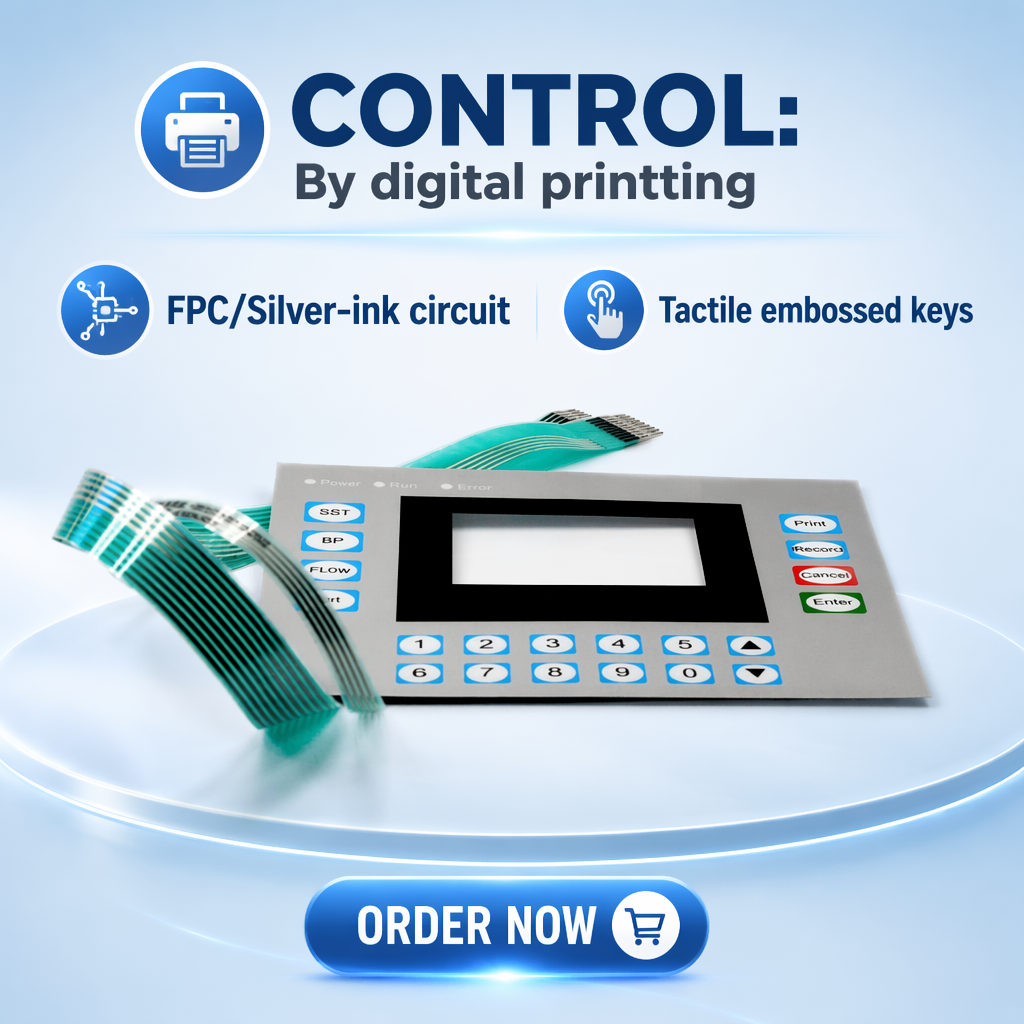
Standalone rubber keypads are increasingly replaced by integrated HMI modules. Chinese factories now mold rubber button mats designed to sit directly over high-density Flexible Printed Circuits (FPC) or rigid FR4 PCBs with pre-soldered SMT LEDs and microcontrollers. This turnkey sub-assembly approach eliminates component assembly steps on the OEM buyer's primary assembly line, drastically reducing overall supply chain complexity and field failure rates.
2. Advanced Backlighting: LGF (Light Guide Film) & Cap-Sense Hybrids
Traditional single-LED point lighting is being rapidly superseded by Light Guide Film (LGF) backlighting. By placing an ultra-thin (0.125mm–0.25mm) optical polycarbonate film beneath the rubber keypad, light from side-firing SMT LEDs is evenly distributed across large key areas with zero hotspotting and minimal power consumption. Furthermore, hybrid keypads combining capacitive touch sensing keys for slick menu navigation alongside mechanical rubber push buttons for critical safety operations (such as power and emergency stop) represent the modern industrial standard.
3. Antimicrobial Coatings and Extreme Environment Sealing
Accelerated by medical equipment demands, silicone rubber formulations are now blended with silver-ion antimicrobial additives that continuously inhibit bacterial growth on key surfaces. Concurrently, overmolding techniques that combine metal backers, rigid plastic housings, and silicone seals into a single vulcanized unit enable true IP68 immersion-proof keypads capable of withstanding high-pressure washdowns in food processing and marine environments.
4. Sustainable Polymeric Formulations & Eco-Compliance
Global regulatory frameworks such as EU RoHS 3, REACH, and California Prop 65 have made toxic plasticizer elimination mandatory. China's top factories utilize food-grade, biocompatible silicone resins free from aromatic hydrocarbons and heavy metal catalysts. Eco-friendly water-based polyurethane surface coatings are replacing traditional solvent-heavy paints, reducing VOC emissions during manufacturing without compromising wear performance.
Procurement & Engineering Playbook: Frequently Asked Questions (FAQ)
Ready to Engineer Your Custom Rubber Push Button Assembly?
Connect directly with our senior HMI engineering team. We provide complimentary DFM (Design for Manufacturability) reviews, material stack-up evaluations, and fast prototype quotations.
Send an Inquiry